Tim Montgomerie: Biography, Age, Family, Career & Health
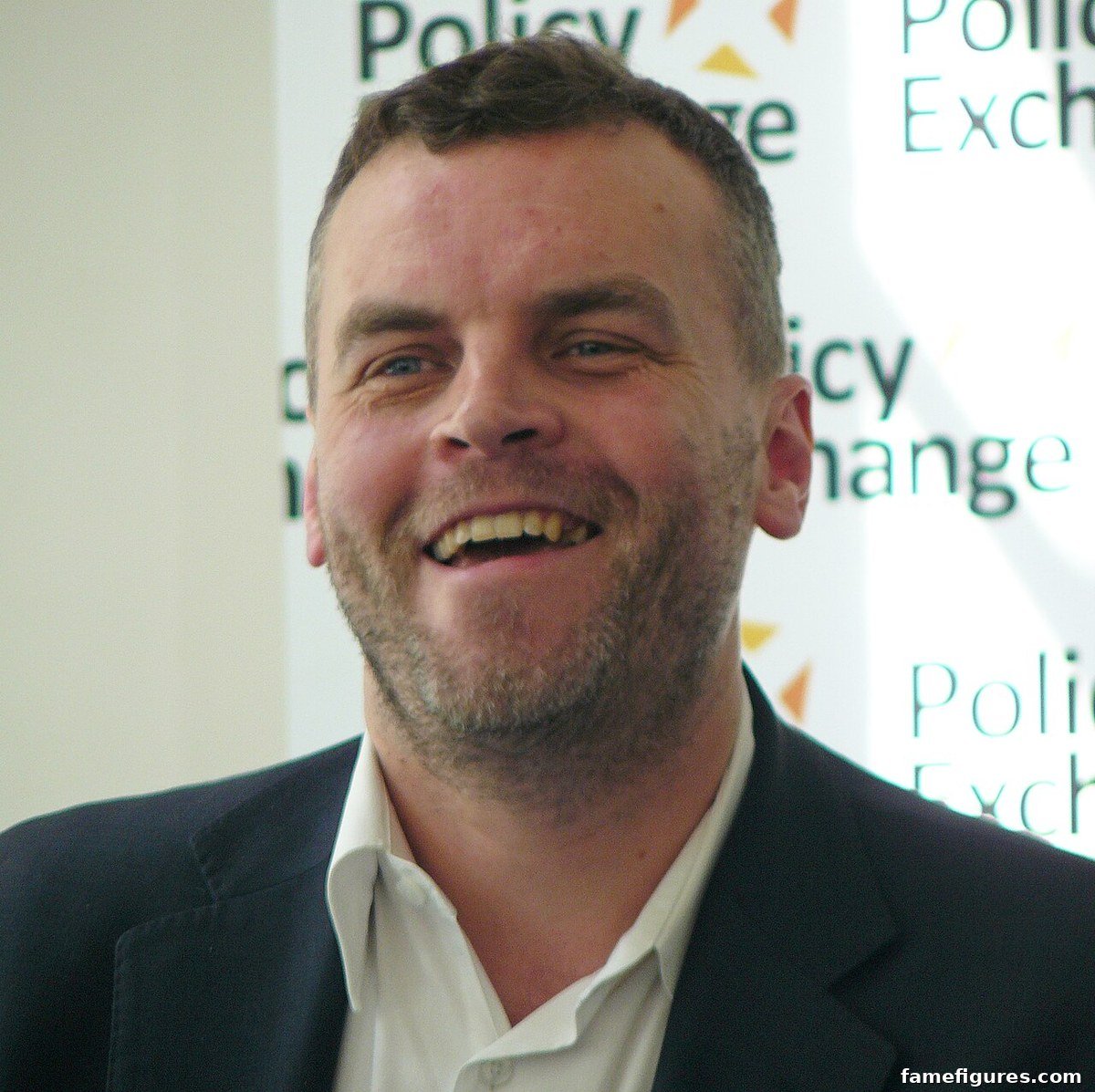

For twenty years, Tim Montgomerie has been one of the most recognisable — and most argued-about — voices on the British right. He built ConservativeHome from a one-man blog into the website every Tory MP read before breakfast, helped found a think tank that changed how the Conservative Party talked about poverty, and then walked away from the party he had served for three decades to join Reform UK — only to leave that party too, less than two years later. Along the way he has been a Bank of England statistician, a speechwriter to two party leaders, a comment editor at The Times and an adviser to a prime minister. And in recent years his name has become one of the most searched in British politics for a very different reason: questions about his health. This is the full story of his life, his career and what is actually known about his health.
Quick Facts
| Full name | Timothy Montgomerie |
| Date of birth | 24 July 1970 |
| Age | 56 years old |
| Birthplace | Barnstaple, Devon, England |
| Nationality | British |
| Education | King’s School, Gütersloh, Germany; University of Exeter — Economics and Geography |
| Occupation | Political commentator, blogger and columnist |
| Known for | Founder of ConservativeHome; co-founder of the Centre for Social Justice |
| Career highlights | Comment editor, The Times (2013–2014); founder, UnHerd (2017); social justice adviser to Boris Johnson (2019) |
| Political party | None — left Reform UK in September 2026 (previously Conservative Party; Reform UK 2024–2026) |
| Wife | Not publicly known — he keeps his private life private |
| Children | None publicly known |
| Faith | Christian |
Early Life and Education
Timothy Montgomerie was born on 24 July 1970 in Barnstaple, Devon, into an army family. His father served in the British Army, so his childhood was a moving one — spent between Devon, Hampshire, Northern Ireland and Germany, on or near military bases. It was an upbringing that gave him an early sense of discipline, duty and national identity.
He was educated at the King’s School in Gütersloh, Germany, a secondary school run by Service Children’s Education for the children of British military personnel stationed abroad. Some online biographies place him at King’s School in Taunton instead — that is wrong, and it is one of several small errors that circulate about him on the internet.
From there he went to the University of Exeter, where he studied Economics and Geography. Exeter was where the politics took hold. He ran the university’s Conservative Association alongside three fellow students who would all go on to become Conservative MPs — Robert Halfon, Sajid Javid and David Burrowes. In December 1990, he and Burrowes founded the Conservative Christian Fellowship, an organisation that set out to bring Christian values into Conservative politics. Montgomerie would serve as its director for the next thirteen years, until 2003.
Faith was not a late addition to his politics; it was there from the start. He has said that he discovered evangelical Christianity at sixteen, and that it tempered what he has called his “teenage Thatcherism”. The free-market economics stayed, but they were joined by a conviction that politics should care about the poor, the addicted and the left-behind. His political hero, he has often said, is William Wilberforce, the campaigner who fought slavery on Christian conviction.
His first job after university was about as far from Westminster as you could get. From 1992 to 1998 he worked at the Bank of England as a statistician, where his responsibilities included the Russian economy and the study of systemic risk in financial systems. The City experience later fed into his writing — most directly into a 2015 report for the Legatum Institute, “Restoring Faith in Capitalism”, which was launched by the Chancellor of the Exchequer.
Career
Speechwriter, Chief of Staff and the Centre for Social Justice
From 1998 to 2003, Montgomerie was a speechwriter for two Conservative Party leaders, William Hague and Iain Duncan Smith. He also took responsibility for the party’s outreach to faith communities and the voluntary sector — the first sign of the “compassionate conservatism” that would become his calling card. In September 2003 he was promoted to Duncan Smith’s Chief of Staff, but the job lasted barely two months: Duncan Smith was ousted as party leader that November, replaced by Michael Howard, and Montgomerie went with him.
Out of that defeat came his most lasting piece of institution-building. In 2004, together with Iain Duncan Smith and Philippa Stroud, Montgomerie established the Centre for Social Justice, a think tank set up to carry forward the work on compassionate conservatism that Duncan Smith had begun as leader. Its aim, in the tradition of Wilberforce and the Victorian reformers, was to make the condition of the poor a political priority — tackling the causes of poverty, addiction, family breakdown and educational failure rather than just managing their symptoms. The Centre went on to become one of the most influential think tanks on the British right.
It is worth noting how far Montgomerie himself has travelled on some of the issues he started out with. In his early years at the Conservative Christian Fellowship he argued that the party should form closer links with churches on issues such as homosexuality and Section 28. He has since reversed that position entirely, and by 2015 he was publicly supporting the introduction of same-sex marriage in England and Wales, arguing that it would strengthen the institution of marriage rather than weaken it.
ConservativeHome — the Blog That Changed Tory Politics
On 28 March 2005, just before that year’s general election campaign, Montgomerie launched ConservativeHome. The idea was simple and, at the time, radical: a website that gave ordinary Conservative members a voice, published grassroots polling, and held the party leadership to account in public. Within a few years it had become the first thing many Tory MPs, journalists and activists read in the morning. In September 2006, The Independent described Montgomerie as “emerging as a major player in Tory politics”. He used the site to criticise David Cameron’s A-list of parliamentary candidates and to press the new leader for specific pledges on tax cuts.
ConservativeHome also became a campaigning machine. With Conservative MP John Hayes, Montgomerie set up conservativedemocracy.com, which successfully co-ordinated grassroots opposition to Michael Howard’s attempt to abolish the “one member, one vote” rule in the 2005 Conservative leadership election. After the 2010 general election he wrote “Falling short”, a report sharply critical of David Cameron’s election campaign. By then, his standing was such that Daniel Finkelstein had described him in The Times in 2009 as “one of the most important Conservative activists of the past 20 years”, and The Observer said in February 2012 that “in the eyes of most MPs, Montgomerie [is] one of the most influential Tories outside the cabinet”.
The Times, UnHerd and Life as a Columnist
Alongside the website, Montgomerie built a career in print. In April 2011 he became a columnist for The Sunday Telegraph, but resigned that October after a series of attacks on him by the paper’s Mandrake column. He became a columnist for The Times soon after, and in February 2013 he announced that he would join the paper as its comment editor that April, replacing Anne Spackman, while keeping a role as an adviser and weekly blogger for ConservativeHome. He resigned from The Times in March 2014, after barely a year in the job. His articles have appeared across the spectrum of British newspapers — The Guardian, The Times, the Daily Mail, The Independent and the Financial Times — and he became a familiar face on BBC political programmes, from Radio 4’s Today, Any Questions? and The Westminster Hour to television’s Newsnight, Question Time and the Andrew Marr Show. He now shares panel-show benches with a newer generation of right-of-centre broadcasters, including GB News presenter Chloe Dobbs, whose biography we have also profiled.
In February 2016, Montgomerie made one of the most public breaks of his career: he resigned his membership of the Conservative Party, writing in The Times that he was quitting over the leadership’s stance on Europe, which was then supportive of EU membership. It put him on the Leave side of the referendum debate four months before the vote. The following year he founded UnHerd, an online magazine designed to publish writers from left and right who wanted to investigate “unheard” ideas — but he left the site in September 2018, barely a year after launching it.
Adviser to Boris Johnson — and the Break with Him
In September 2019, Montgomerie was appointed as social justice adviser to Prime Minister Boris Johnson, working out of the Cabinet Office in Downing Street. It was a brief appointment — the role lasted only until the general election was called in November 2019 — but it put him back at the centre of power after years on the outside. By May 2020, however, he had become a frequent critic of the government, above all of the Prime Minister’s senior adviser Dominic Cummings and of Johnson himself. In June 2020 he set out the break in a New Statesman piece headlined “Why I broke with Boris Johnson”.
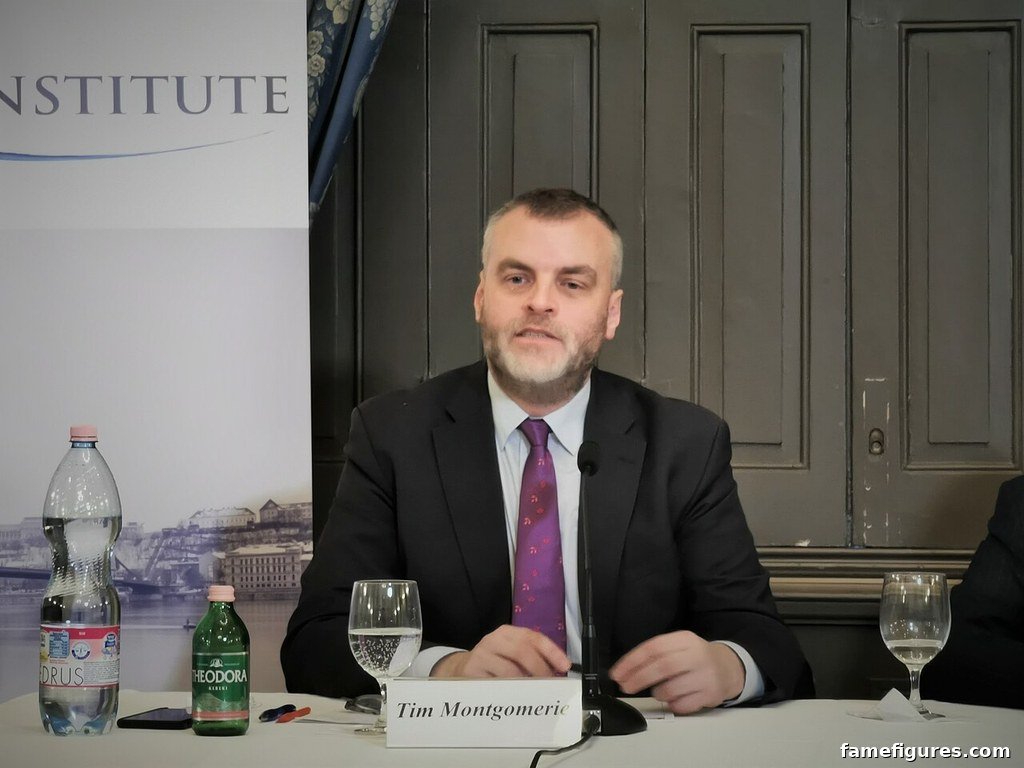
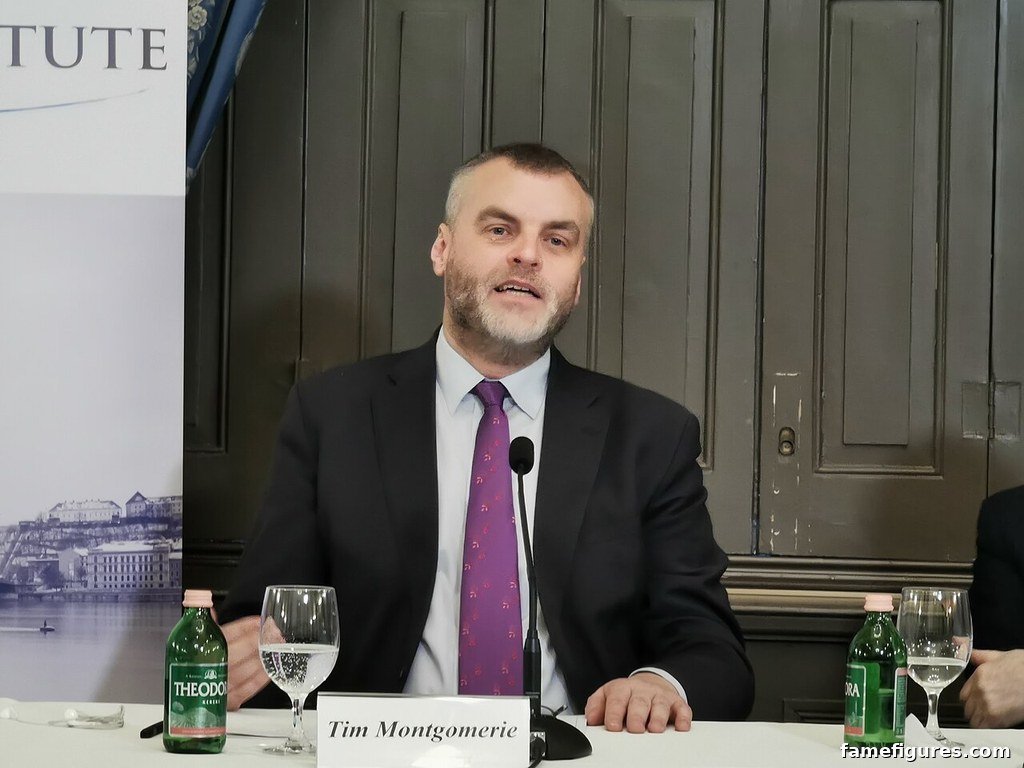
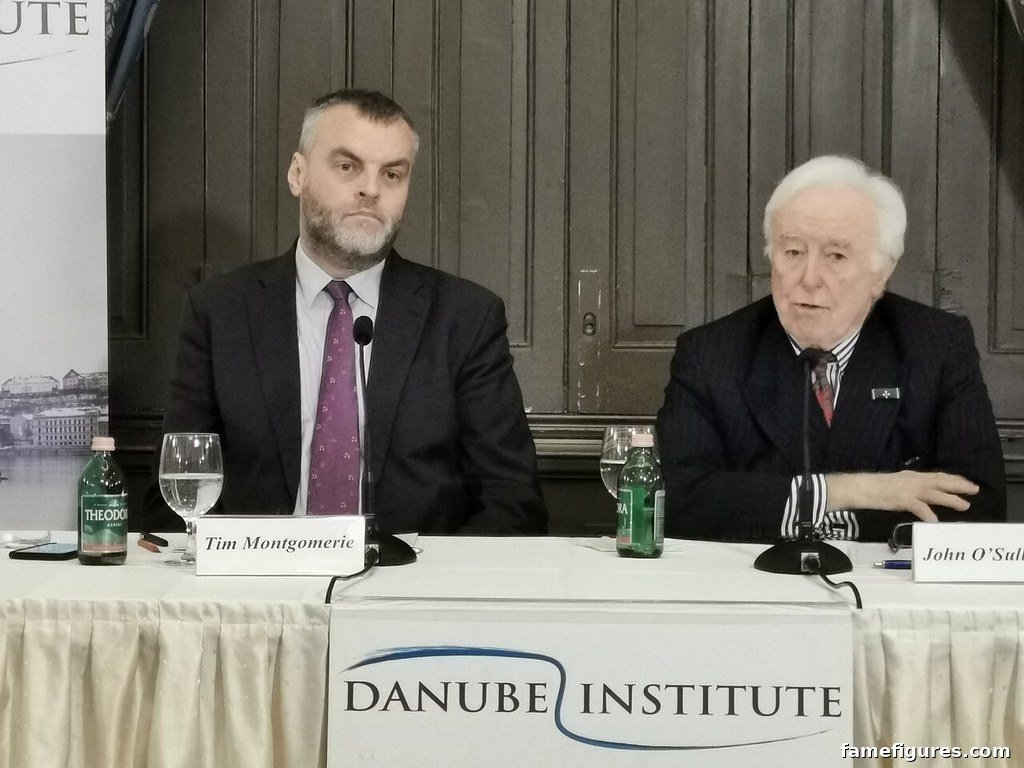
The same year brought a controversy that still follows him. At a meeting of the Danube Institute in Budapest, Montgomerie was reported as saying that the British government should have a “special relationship” with Hungary after Brexit, praising the country as a home for “interesting early thinking on the limits of liberalism”. The Labour Party called for his removal from his advisory role. He has been a regular visitor to the Danube Institute’s events in Budapest — the photographs on this page come from its December 2019 conference on the British general election, held days after Johnson’s landslide victory.
Reform UK — Joining, Suspension and Exit
During the 2024 general election campaign, Montgomerie said publicly that if he lived in certain constituencies he would vote for the Reform UK candidate — including Nigel Farage in Clacton and Richard Tice in Boston and Skegness. In December 2024 he went further, quitting the Conservative Party after 33 years and joining Reform UK. For Farage’s party, capturing the founder of ConservativeHome was a coup, announced with much fanfare.
It lasted less than two years. In August 2026, Reform UK suspended him after he publicly criticised the party’s home affairs spokesperson Zia Yusuf — telling a Spectator podcast that Yusuf needed to become a “team player” — and after he told the BBC he was frustrated by Farage’s “aggrieved” tone following the Clacton by-election. Montgomerie told BBC Newsnight he would fight the suspension, calling it a test case of whether Reform could tolerate free speech and dissent. Reform’s leadership said he had been suspended in line with party rules after months of complaints about his behaviour.
The following month, in September 2026, he left the party altogether, after a conversation with party chair Lee Anderson. He said he still wanted to be a supporter, “but that requires them being more like Reform and less like the AfD”, and he insisted he had no intention of rejoining the Conservative Party. At 56, Tim Montgomerie now finds himself politically homeless for the first time in his adult life — a commentator without a party, still writing, still broadcasting, and still arguing with whoever is in charge.
Tim Montgomerie Health Problems: What Is Actually Known
Searches for “Tim Montgomerie health problems” have grown sharply online — but the verified picture is much narrower, and much quieter, than the search results suggest. The only health matter Montgomerie has spoken about publicly is his mental health during the COVID-19 lockdowns. He has never reported a chronic physical illness, and no credible news organisation has documented one. Everything beyond that — including online claims about cancer, stroke and chronic disease — is unverified rumour, not reported fact.
What he has discussed, in reports of an interview he gave, is a period of real difficulty during the pandemic. Living alone through the lockdowns, cut off from normal routines and company, he described reaching what he called “dark places” emotionally, and spoke of depression brought on by isolation and professional pressure. He sought counselling, and was prescribed short-term antidepressant medication, which he said helped to stabilise him but left him feeling flattened and short of enthusiasm. He later chose to come off the medication under medical guidance. Two cautions belong with that account: the details come from secondary reports of his interview comments rather than from a widely available transcript, so they should be read as his own reported account rather than as a medical record — and the difficult period he described was the lockdown era of 2020 and 2021, not a new diagnosis announced in any later year.
One friendship mattered a great deal during that period. Sir David Amess, the Conservative MP who was tragically killed in October 2021, was a close friend who regularly checked in on Montgomerie and encouraged him to reach out whenever he felt low. Montgomerie has spoken publicly about how much that support meant to him. He has also used the experience to argue that governments overlooked the emotional cost of lockdowns, and that mental well-being should be weighed alongside physical health when public policy is made.
To be clear about what is not known: there is no reliable public evidence that Montgomerie has had a stroke, or that he lives with Parkinson’s disease, cerebral palsy or any other neurological condition. Some online discussions have speculated about changes in his speech, but no credible source has confirmed any diagnosed speech disorder, and forum comments are not medical assessments. He is also sometimes confused online with Tim Montgomery, the American sprinter involved in a doping scandal — a different person entirely. As of late 2026, Montgomerie remains active in public life, writing and broadcasting regularly, which sits uneasily with any suggestion of a serious ongoing illness.
Personal Life
So, who is Tim Montgomerie away from politics? The honest answer is that very little is publicly known — and that is by his own design. He is a Christian, and his faith is the one part of his private life he has always been open about: the evangelical Christianity he discovered at sixteen, the Conservative Christian Fellowship he ran for thirteen years, and the Wilberforce-inspired social conscience that shaped the Centre for Social Justice. Beyond that, he guards his privacy closely. He has never publicly introduced a wife or partner, and no children are publicly known. Gossip sites describe him as single, but no reliable source confirms even that — so the only honest statement is that his relationship status is not publicly known.
What is clear is that the faith and the politics are not separate compartments for him. The same convictions that took him into the Bank of England, into Downing Street and then out of two political parties also explain the causes he returns to again and again: poverty, addiction, family breakdown and the people politics forgets. Whether you agree with his conclusions or not, the through-line of his life is unusually consistent.
If you enjoy reading about the people behind British broadcasting, FameFigures has also profiled BBC presenters Roo Irvine and Sarah Keith-Lucas — two very different careers from Montgomerie’s, but the same behind-the-scenes storytelling.
FAQs
How old is Tim Montgomerie?
Tim Montgomerie is 56 years old. He was born on 24 July 1970 in Barnstaple, Devon, England.
Is Tim Montgomerie married?
No wife or partner is publicly known. Tim Montgomerie keeps his private life out of the public eye, and he has never publicly introduced a wife or partner. No children are publicly known either.
What health problems does Tim Montgomerie have?
The only health matter Tim Montgomerie has spoken about publicly is his mental health during the COVID-19 lockdowns. He has described experiencing depression linked to lockdown isolation, and has spoken of counselling and short-term antidepressant medication, as reported in interviews. There is no verified evidence of any chronic physical illness.
Has Tim Montgomerie had a stroke?
There is no credible public evidence that Tim Montgomerie has had a stroke. No reputable news organisation has reported one, and the claims circulating online are unverified rumours. The same applies to suggestions of Parkinson’s disease or cerebral palsy — none of them has any reliable source behind it.
What is Tim Montgomerie’s net worth?
There is no official or reliable figure. Tim Montgomerie has never disclosed his earnings, and the net worth numbers published online conflict wildly with each other — ranging from around $1 million to $5 million — with none of them backed by a credible source. Any exact figure you see should be treated as a guess, not a fact.
Why did Tim Montgomerie leave Reform UK?
Tim Montgomerie was suspended from Reform UK in August 2026 after publicly criticising the party’s home affairs spokesperson Zia Yusuf and leader Nigel Farage. He left the party the following month, in September 2026, saying he still wanted to be a supporter but that the party needed to be “more like Reform and less like the AfD”. He has said he has no intention of rejoining the Conservative Party.
What is ConservativeHome?
ConservativeHome is the political website Tim Montgomerie founded on 28 March 2005 to give grassroots Conservative Party members a voice and to hold the party leadership to account. He edited it until 2013, when he left to become comment editor at The Times. It remains one of the most influential websites in British conservative politics.